Which Greek Island Should You Visit? A Decision Guide
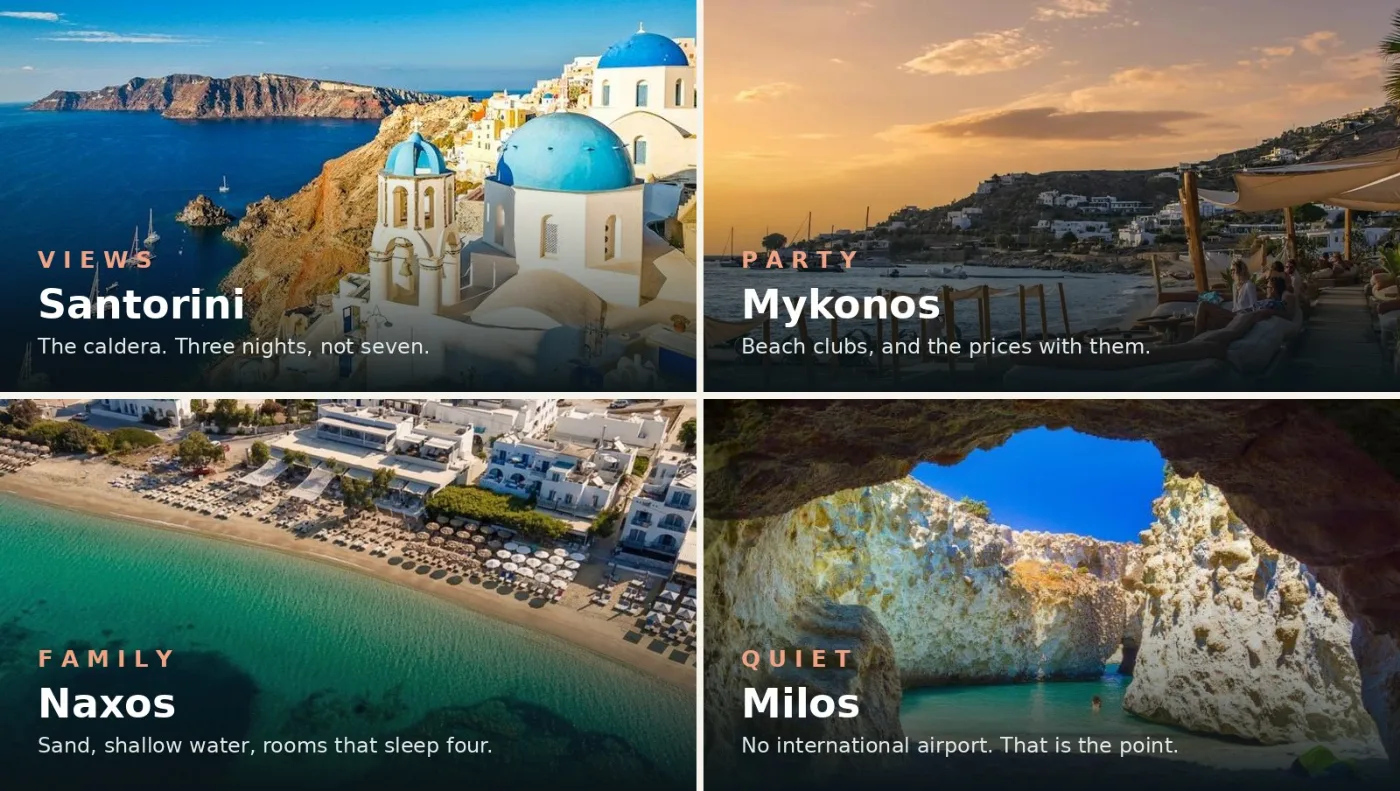
A ferry from Athens is 2h30m to over 11 hours, and it is a travel day either way. Thirteen islands take direct international flights; the rest go through Athens or by boat.
Greek islands sit in seven clusters, and ferries run well inside a group and badly between them. One cluster per trip is the single most useful planning rule in the country.
First trip, and you want it to just work: Naxos or Paros as a base, plus two nights on Santorini if you want the caldera. Everything below is how to get to a different answer on purpose — by season, by budget, by crowd, and by what the trip is actually for.
Greece has more than 200 inhabited islands, and roughly fifteen that anyone actually chooses between. The internet will hand you a ranked list of all fifteen and tell you Milos is underrated. That is not a decision, it is a mood board.
The reason people end up disappointed in Greece is almost never that they picked a bad island. It is that they picked a good island for someone else's trip: five days in Santorini when they wanted beaches, a Mykonos honeymoon in August wind, a two-island week that turned out to need a ferry, a flight and a rental car.
So this guide runs in the order the decision actually happens. Five constraints first, taste last. By the time you get to the vibe section, most of the list has already eliminated itself.
Which Greek Island Should You Visit? The Short Answer
First trip to Greece: Naxos or Paros as your base. Both have long sandy beaches, real towns, cheap rooms and the best ferry connections in the Aegean. Add Santorini for two nights if you want the caldera, not seven.
Views and a honeymoon: Santorini, and pay for the caldera side or do not bother. Folegandros if you want the same cliffs without the crowd.
A party: Mykonos, or Ios if you are under 25 and would rather not remortgage.
Family with young kids: Naxos, Crete or Kefalonia. Shallow sandy beaches, short transfers from the airport, and enough hotel stock that a room sleeping four exists.
Quiet, and cheap: Milos, Sifnos, Karpathos, Ikaria. Fewer flights, fewer people, better prices.
You do not want a ferry from Athens: Crete, Rhodes, Corfu or Kos. Fly straight in, stay on one island, rent a car.
The five constraints behind that answer, in the order they matter:
- Can you fly there, or is it a ferry day? A crossing from Athens runs from about 2h30m to over 11 hours. That is a travel day either way, and it comes out of your holiday.
- Which cluster is it in? Greek islands come in seven groups, and ferries run inside a group far better than between them. Picking two islands from two clusters is how a week becomes a commute.
- How crowded is it? Santorini takes about 3.4 million visitors against 15,500 residents. Crete takes 5.35 million against 624,000. Those are different holidays.
- When are you going? July and August bring the Meltemi, which cancels ferries in the Cyclades and leaves the Ionian alone. October empties the islands and starts closing them.
- What will you spend? Outside the peak weeks, rooms on Naxos start in the €20 to €60 band. A caldera room on Santorini sits in the €200 to €800 and up band. Same country, same week.
What No Guide Tells You
The ferry is a day, not a transfer. A 4-hour crossing means leaving the hotel at 8, arriving at 2, and finding your room at 4. Two ferry days in a seven-night trip is nearly 30% of your holiday. Count them as days when you plan, because your body will.
"Has an airport" and "you can fly there" are different claims. Most island airports get a thin seasonal schedule from a few European hubs. Check whether a direct route exists from your actual city before you build a trip around it, or you will be routing through Athens anyway.
A room for four is the real constraint on the small islands. Family rooms are a small fraction of inventory on the Cyclades and they go early. If you are four people, the island choice is made by the room, not by the beach.
The famous islands are better in the shoulder than the unfamous ones are in August. Santorini in late September beats a quiet island in the wind. If your dates are flexible, move the dates before you downgrade the destination.
Nobody regrets fewer islands. Every itinerary we have seen go wrong went wrong by adding one more. The trip people describe as perfect afterwards is almost always two islands, or one.
1. Can You Fly There, or Is It a Ferry Day?
The question is not whether an island has an airport. It is whether you can fly to it from where you live. Airport classifications are a Greek administrative fact; direct routes are the thing that decides your trip, and they are seasonal.
Which Greek Islands Can You Fly To?
Sorted by what it actually takes to arrive:
- Direct international flights, depending on your city and the season. Crete (Heraklion, Chania and Sitia), Corfu, Kefalonia, Zakynthos, Rhodes, Kos, Samos, Lesvos, Limnos, Karpathos, Mykonos, Santorini and Skiathos. Most of these are served by seasonal routes from a handful of European hubs rather than by a year-round network, so check your own city before you build a trip around one.
- Domestic flights, connecting through Athens. Naxos, Milos, Syros, Ikaria, Chios, Kalymnos, Leros, Astypalaia, Kythira, Skyros, Kasos and Kastellorizo. Paros belongs here in practice too: it has an international-standard airport, but international routes have not operated there for a couple of years.
- Ferry only. Everything else, including Ios, Sifnos, Folegandros, Amorgos, Symi, Hydra, Spetses, Skopelos and Alonissos. On the small Cyclades this is a feature rather than a flaw, and it is most of the reason they stay quiet.
Two things catch people out. A connection through Athens is often slower door to door than the ferry once you count the transfer and two hours at the gate. And a route that existed last August may not exist this one; island schedules get rewritten every season.
How Long Is the Ferry from Athens?
| Island | Fastest crossing | Slowest | Departures in summer |
|---|---|---|---|
| Mykonos | 2h 30m | 5h 30m | 2 daily from Piraeus, 7+ from Rafina |
| Milos | 2h 40m | 7h 10m | About 6 daily from Piraeus |
| Paros | 2h 50m | 6h 20m | 6+ daily across both ports |
| Naxos | 3h 05m | 8h 55m | 6+ daily, average crossing 5h |
| Santorini | 4h 45m | 11h+ | Up to 8 daily, from about €46.50 |
| Crete (Heraklion) | 9h 05m | 11h 15m | 2 to 4 daily, mostly overnight |
Swipe sideways for the full table →
The spread inside each row is the thing to notice. The same route can take twice as long depending on whether you booked the high-speed catamaran or the conventional ferry that stops at three islands on the way. Booking the cheap one and discovering it is the 11-hour sailing is one of the most common ways to lose a day in Greece.
Crete is the outlier worth understanding: the crossing is basically an overnight, which is either a wasted day or a free hotel night depending on how you look at it. Most people fly.
2. Which Cluster Is It In? Why Santorini and Corfu Is a Bad Week
Greek islands sit in seven groups, and ferries run frequently inside a group and badly between them. As a default, choose one cluster per trip. This is the single most useful planning rule in the country, and the one most first-time itineraries break.
- Cyclades. Santorini, Mykonos, Naxos, Paros, Milos, Ios, Sifnos, Folegandros, Tinos, Syros, Amorgos. The centre of the Aegean, the best-connected group in Greece, and the one everyone pictures. Whitewashed, dry, windy.
- Dodecanese. Rhodes, Kos, Karpathos, Symi, Patmos, Leros, Kalymnos. Southeast, closer to Turkey, greener and more layered historically. Medieval Rhodes is a different thing from a Cycladic village.
- Ionian. Corfu, Kefalonia, Zakynthos, Lefkada, Paxos. West coast, green rather than bare, Italian-influenced, and reached from the mainland rather than from Athens' port. There is no Piraeus ferry to Corfu.
- Sporades. Skiathos, Skopelos, Alonissos. Pine forests down to the water, northeast of Athens.
- Saronic. Hydra, Spetses, Aegina, Poros. One to two hours from Athens, which makes them the only islands that work as a two-night add-on to a city trip.
- North Aegean. Lesvos, Samos, Chios, Ikaria, Limnos. Big, lived-in islands close to the Turkish coast, with the thinnest tourist infrastructure of any group and the most local life left in them. Domestic flights or long overnight ferries.
- Crete. Big enough to be its own holiday. Five to seven days minimum and a rental car, or you will spend the week on the north coast wondering what the fuss is.
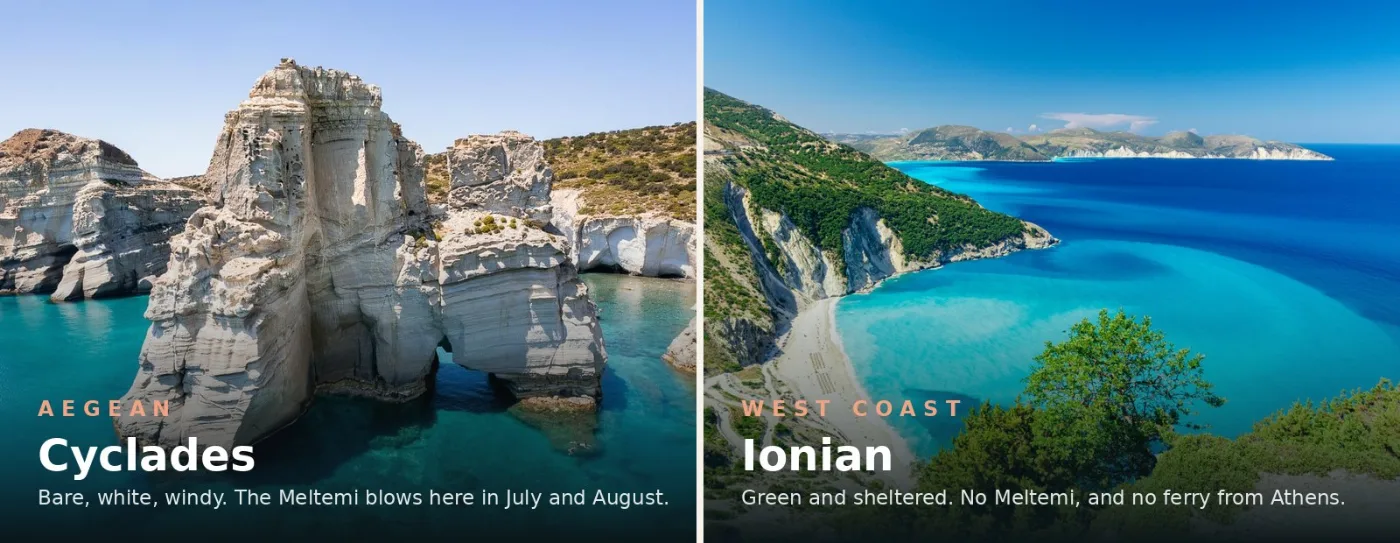
The two extremes are the Cyclades and the Ionian, and they are barely the same holiday. One is bare rock, white villages and wind. The other is pine, olive and calm water. Most people picture the first and would be happier with the second, or the other way round, and almost nobody checks before booking.
The practical version of the rule: one cluster per trip as a default, and no more than three islands in ten days. Two islands in a week is comfortable. Three in ten days is doable. Four is a logistics exercise you paid for. The same rule holds anywhere the map is bigger than it looks — it is why our guide to choosing a Brazil destination opens on flight times rather than on beaches.
Santorini and Corfu is the classic mistake because they are in different seas. Getting between them means flying back through Athens, which costs you the best part of two days out of seven.
The rule has honest exceptions. Athens plus a Saronic island plus one Cycladic island works, because the Saronic hop is 1 to 2 hours. And crossing clusters is fine if you plan it as a flight rather than discovering mid-trip that it has to be one. The failure mode is not ambition, it is assuming a boat exists.
3. How Crowded Is It?
Crowding on Greek islands is not evenly distributed. Some islands carry vastly more tourism relative to their resident population than others, and the gap is enormous. The useful comparison is annual tourist volume against the number of people who actually live there, because it tells you whether you are visiting a place or queueing at one.
| Island | Annual tourism measure | Residents | Ratio |
|---|---|---|---|
| Santorini | ~3.4m visitors | 15,500 | ~220 : 1 |
| Mykonos | ~2.2m visitors | 10,704 | ~180–200 : 1 |
| Zakynthos | ~6m overnight stays | ~40,000 | ~150 : 1 |
| Skiathos | ~500,000 visitors | 6,088 | ~80 : 1 |
| Paros | ~450,000 visitors | ~12,000 | ~37–40 : 1 |
| Corfu | ~2.5m overnight visitors | ~100,000 | ~30–35 : 1 |
| Rhodes | ~3.5m visitors | ~115,000 | ~25–30 : 1 |
| Crete | ~5.35m airport arrivals | ~624,000 | ~8–10 : 1 |
Swipe sideways for the full table →
The Crowd Is a Two-Hour Problem, Not an All-Day One
Here is the thing the ratios hide. On Santorini and Mykonos the crush is concentrated by cruise arrivals and by sunset, not spread across the day. Oia at 7pm in August is genuinely unpleasant. Oia at 9am is a village.
Greece has started pricing this directly. Since 1 July 2025 cruise passengers landing on Santorini or Mykonos pay a levy of €20 from 1 June to 30 September, €12 in October, and €4 from November to March. Mykonos took 768 cruise ships and 1.29 million cruise passengers in 2024, which is the number the levy is aimed at.
If you are staying overnight rather than arriving by ship, the levy is not your problem, but the crowd it is trying to manage is. Stay on the island, eat late, and go to the famous viewpoint in the morning.
The ratio is not a Greek problem either. Venice runs about 20 visitors to every resident and has started charging day-trippers for it; Florence and Rome are not far behind. Scoring crowds against cost reorders that list the way it reorders this one, which is what our comparison of the best cities in Italy does across twelve of them.
4. When Are You Going? Season, and the Meltemi
May, June, September and early October are the best months on almost every Greek island. July and August are hot, expensive, crowded, and windy in the wrong places. November to March, most island tourism simply stops.
| Period | What it is like |
|---|---|
| April to mid-May | Green, cool, cheap. Sea is cold. Many hotels and restaurants not open yet, especially on small islands. |
| Late May to June | The best compromise. Warm, swimmable, everything open, crowds still manageable. |
| July to August | Peak everything. Highest prices, fullest islands, strongest Meltemi. Fine if you want the party; a poor trade otherwise. |
| September | Warm sea, thinning crowds, prices easing. Widely the best month if you can travel then. |
| October | Quiet and good value, but the season starts folding: ferry frequency drops, small hotels close, and the weather turns by mid-month. |
| November to March | Crete, Rhodes and Corfu keep functioning. Most small islands do not. |
Swipe sideways for the full table →
What the Meltemi Does, and Which Islands It Hits
The Meltemi is a dry north wind that blows across the Aegean from June to September and peaks in July and August, commonly at force 7 to 8 and occasionally over 120 km/h.
It matters because it cancels boats. Large conventional ferries usually run through it; high-speed catamarans and small-port arrivals are the first to be cancelled. In mid-August 2026 the wind was strong enough to trigger sailing bans out of Rafina and Lavrio and cancellations from Piraeus.
Geography decides how exposed you are:
- Worst hit: the Cyclades, especially Mykonos, Andros and Tinos.
- Also affected: the Sporades, the Dodecanese and Crete's north coast.
- Largely unaffected: the Ionian islands, on the other side of the country.
Two consequences worth planning around. If you are flying home from a Cycladic island in August, do not book the last ferry connection on the last day; leave a night in Athens. And if you want reliable calm water in August, the Ionian is not a compromise, it is the correct answer.
5. What Will It Cost?
Accommodation is where Greek islands separate, and the gap is roughly tenfold between the cheapest and the most expensive. Food, ferries and car hire barely move by comparison.
| Tier | Typical per night | Islands |
|---|---|---|
| Budget | €20–60+ | Naxos, Paros, Milos, Ios and the less-famous Cyclades |
| Mid-range | €80–180 | Crete, Rhodes, Corfu, and the better end of Paros and Milos |
| Premium | €200–800+ | Santorini caldera-facing, Mykonos, Hydra |
Swipe sideways for the full table →
Read those as floors, not as what you will pay in August. The bottom of the budget band is a shoulder-season room in a domatia, not a July hotel on Naxos. Every band moves up in the peak weeks and the cheap end of the first one largely disappears. Use the tiers to rank islands against each other, which is what they are good for, and get real prices for your actual dates before you budget.
Food is the great equaliser and stays cheap almost everywhere: a gyros runs €3 to €4.50, a taverna lunch with a salad and a main is €10 to €15 a head, a mid-range dinner with wine €20 to €30, and a waterfront seafood dinner €30 to €50.
Ferries are a real line item once you start hopping. Athens to Santorini starts around €46.50 one way per adult, and high-speed vessels cost meaningfully more than the conventional boats on the same route. A three-island week for two people adds up to a line in the budget that most people forget entirely.
The caldera premium is the biggest single decision in Greek island budgeting. It is the reason Santorini sits in the €200 to €800 and up band while comparable hotels on Crete or Rhodes sit at €80 to €180. If the view is the reason you are going, pay for it; that is what you came for. If the caldera is not the reason, you are probably better off spending that money on another island than on a cheaper room on this one. Whichever way you go, the room is the number worth watching: hotel rates often fall in the last two weeks on a soft date, and a Greek island in the shoulder season is exactly that.
What Do You Actually Want? Choosing by Vibe
The constraints have done most of the work by now. This part is the preference — and the four islands at the top of this page are four genuinely different holidays, not four ranks on one list.
Which Greek Island Is Best for First-Timers?
Want the Cycladic postcard without the Cycladic prices? Go to Naxos or Paros, because they have the beaches and the ferry connections and none of the premium. Both give you the postcard, long sandy beaches, a proper town that exists in winter, food that is not priced for honeymooners, and the best ferry connections in the group if you want to add a second island. Naxos is bigger, greener and better for families; Paros is livelier and better connected.
Neither is the island you have seen in photographs, and that is the point. Use one as a base and take Santorini in a two-night dose.
Which Greek Island Is Best for Couples and Views?
Want the view? Go to Santorini, because nothing else in Greece looks like the caldera. The sunset is not overrated and no amount of contrarianism changes that. Book caldera-facing, go to Oia early rather than at sunset, and stay three nights rather than seven.
Folegandros is the real alternative rather than the consolation prize: the same volcanic cliffs and a hilltop Chora, a fraction of the people, and no airport, which is exactly why.
Which Greek Island Is Best for a Party?
Want the party? Go to Mykonos, and it is not close. The beach clubs and the prices come together. Ios is the younger, cheaper version. Both are in the Cyclades, both are windy in August, and both are places you go deliberately rather than by accident.
Which Greek Island Is Best for Families?
Travelling with young kids? Go to Naxos, Crete or Kefalonia, because they are the three that clear all of the practical hurdles at once. The criteria that matter are shallow sandy beaches, a short transfer from the airport or port, and enough hotel stock that a room sleeping four actually exists, which on the small Cyclades it often does not.
Crete wins on infrastructure and direct flights. Naxos wins on the beach at Plaka and on being small enough to manage. Kefalonia wins if you want green and calm water, since the Ionian sits out the Meltemi.
Which Greek Island Is Best for Quiet?
Want quiet? Go to Milos, Sifnos, Karpathos, Ikaria or Amorgos, because the thing that keeps them quiet is how hard they are to reach. No international airport, or a very thin one, filters the crowd before you arrive. Milos has the most extraordinary coastline in the Cyclades and a domestic-only airport. Karpathos is genuinely remote and stays that way.
Which Greek Island Is Best for Walking and Hiking?
Crete for the Samaria Gorge and the White Mountains, Naxos for the Tragea valley and Mount Zas, Sifnos for a properly maintained network of old stone paths, Amorgos for cliff walking. Spring and autumn only. Hiking a Cycladic ridge in August is a medical decision, not a holiday.
Which Greek Islands Can You Visit Without a Ferry from Athens?
Crete, Rhodes, Corfu and Kos are the easiest choices if you want to fly in and stay on one island. All four have their own ferry links to neighbours, but none of them requires the long haul out of Piraeus. Fly in, rent a car, never look at a timetable. If your holiday has two weeks of annual leave riding on it and you would rather not spend any of it watching the wind forecast, this is a legitimate and underrated way to do Greece.
The Islands, Compared
| Island | Group | Getting there | Ferry from Athens | Crowds | Price | Best for |
|---|---|---|---|---|---|---|
| Santorini | Cyclades | Direct intl. flights | 4h45m–11h | Extreme | €€€ | Views, honeymoons, 3 nights |
| Mykonos | Cyclades | Direct intl. flights | 2h30m–5h30m | Extreme | €€€ | Nightlife, beach clubs |
| Naxos | Cyclades | Domestic via Athens | 3h05m–8h55m | Moderate | € | First trips, families, hiking |
| Paros | Cyclades | Domestic via Athens | 2h50m–6h20m | Moderate, rising | €–€€ | First trips, island hopping |
| Milos | Cyclades | Domestic via Athens | 2h40m–7h10m | Low–moderate | € | Coastline, quiet, swimming |
| Ios | Cyclades | Ferry only | Via Cyclades routes | Seasonal spikes | € | Younger nightlife |
| Sifnos | Cyclades | Ferry only | Via Cyclades routes | Low | €–€€ | Food, walking paths |
| Folegandros | Cyclades | Ferry only | Via Cyclades routes | Low | €€ | Cliffs without the crowd |
| Crete | Own group | Three intl. airports | 9h+, overnight | Low per head | €€ | Two weeks, cars, hiking, families |
| Rhodes | Dodecanese | Direct intl. flights | Long, fly instead | Moderate | €€ | History, no-ferry trips |
| Kos | Dodecanese | Direct intl. flights | Long, fly instead | Moderate | €–€€ | Easy beach weeks |
| Karpathos | Dodecanese | Direct intl., thin | Long | Very low | € | Remote, wild, windy |
| Symi | Dodecanese | Ferry via Rhodes | Via Rhodes | Low | €€ | The prettiest harbour in Greece |
| Corfu | Ionian | Direct intl. flights | Not from Piraeus | Moderate | €€ | Green, families, no Meltemi |
| Kefalonia | Ionian | Direct intl. flights | Not from Piraeus | Moderate | €–€€ | Families, calm sea |
| Zakynthos | Ionian | Direct intl. flights | Not from Piraeus | Extreme | €–€€ | Beaches, but go shoulder season |
| Skiathos | Sporades | Direct intl. flights | Not from Piraeus | High for its size | €€ | Short trips, pine and sand |
| Hydra | Saronic | Ferry only, no cars | 1.5–2h | Moderate | €€€ | Two nights from Athens |
Swipe sideways for the full table →
Price bands follow a 2026 Greek cost guide where it names the island, and are our own read where it does not. Crowd levels are ours, based on the visitor-to-resident data above and on how concentrated the season is.
Still Not Sure?
That is the normal state, and it is the reason we built Escapada. The narrowing above is mechanical: dates, departure city, budget and how much moving around you will tolerate eliminate most of the list before taste is involved. What is left is a shortlist you can actually choose from — which is exactly what how Escapada works describes.
Tell Max your dates, where you are flying from, roughly what you want to spend and what the trip is for. He will narrow the islands down, tell you which crossings actually connect on your days, and build the trip around the one that fits. He will also tell you when the honest answer is to move your dates rather than your destination. If Athens is your way in or out, where to stay in Athens covers the night at each end.
Max will ask about ages, dates and budget — and build an itinerary with flights, hotels and things to do.
Frequently Asked Questions
Which Greek island should I visit for the first time?
Naxos or Paros, with two nights on Santorini if you want the caldera. Both are well connected, affordable, have real towns and long sandy beaches, and they leave you the option of a second island without a difficult crossing.
Which Greek island is best for couples?
Santorini if the view is the point, and it is worth paying for a caldera-facing room. Folegandros for the same landscape with far fewer people. Symi and Hydra for a quieter, harbour-town version.
Which Greek island is best for families with kids?
Crete for infrastructure and direct flights, Naxos for a manageable island with shallow sandy beaches, Kefalonia for calm Ionian water. Check that rooms sleeping four exist before you commit; on the smaller Cyclades they are scarce.
Which Greek island is the cheapest?
Naxos, Paros, Milos and Ios sit in the €20 to €60 a night band, along with the less-famous Cyclades. Crete, Lefkada, Kefalonia, Samos and Tinos are also consistently good value. Santorini's caldera side and Mykonos are the expensive outliers.
Which Greek islands can you fly to directly?
Thirteen islands get direct international flights: Crete, Corfu, Kefalonia, Zakynthos, Rhodes, Kos, Karpathos, Samos, Lesvos, Limnos, Mykonos, Santorini and Skiathos. Paros has the airport for it but its international routes have not run for a couple of years. Whether a direct flight reaches your own city is a separate and usually seasonal question.
How many Greek islands should you visit in one week?
Two. Three is possible in ten days and starts to feel like a schedule. Every extra island costs you a ferry day at each end, and the crossings are 3 to 6 hours, not 45 minutes.
Can you do Santorini and Mykonos in one trip?
Yes, easily. They are both in the Cyclades and the crossing is around 2 to 3 hours on a high-speed ferry. Whether you should is another question: they are the two most crowded and most expensive islands in Greece, and a week of both is a week of the same thing twice.
Is Santorini worth it?
For two or three nights, yes. The caldera genuinely has no equivalent. For a week, usually not: the beaches are mediocre by Greek standards, the island is dry, and the prices assume you are there for the view. Pair it with a second island rather than stretching it.
When is the best time to visit the Greek islands?
Late May to June, and September. Warm sea, everything open, and crowds and prices below their peak. July and August are the most expensive, most crowded and windiest weeks of the year. October is good value but the season starts closing mid-month.
Which Greek islands are least crowded?
Karpathos, Ikaria, Amorgos, Sifnos and Folegandros, all of which are protected by having no international airport or a very thin one. Among the bigger islands, Crete carries the most visitors in absolute terms but has by far the lowest ratio per resident, around 8 to 10 to 1.
What is the Meltemi and will it ruin my trip?
A strong north wind that blows across the Aegean in summer, peaking in July and August at force 7 to 8. It cancels high-speed ferries and small-port arrivals. It hits the Cyclades hardest and leaves the Ionian islands essentially alone. It will not ruin your trip, but it will move your ferry, so leave a buffer night before any flight home.
Do you need a car on a Greek island?
On Crete, Rhodes, Corfu and Naxos, yes, if you want to see more than one part of the island. On Santorini, Mykonos and the small Cyclades, no; buses, taxis and a scooter cover it, and parking in high season is genuinely miserable.
Which Greek island is best in October?
Crete, Rhodes and Corfu, because they are large enough to keep functioning after the season ends. The sea is still warm, the prices drop, and the crowds are gone. Avoid the small Cyclades in late October, when hotels and ferries both start shutting down.
Do I have to pay the Santorini tourist tax?
Only if you arrive by cruise ship. The levy is €20 from June to September, €12 in October and €4 from November to March, and it applies to Santorini and Mykonos. Travellers arriving by ferry or plane and staying overnight do not pay it.
Sources and Further Reading
- Greek Trip Planner's overtourism data — island-by-island visitor and resident figures, drawn from ELSTAT census records, Bank of Greece tourism surveys and European Commission datasets, 2023 to 2025.
- Time Out on the cruise passenger levy — the €20 / €12 / €4 seasonal rates for Santorini and Mykonos, in force since 1 July 2025.
- Greek Trip Planner on Greek travel costs — 2026 accommodation tiers by island and typical meal prices.
- Ferry crossing times and frequencies from Ferryhopper and Greeka's route pages for Naxos, Paros, Mykonos, Milos and Heraklion.
- Dave's Travel Pages on Greek islands with airports — which islands take international flights and which are domestic only.
- Dave's Travel Pages on the Meltemi winds — timing, strength, and which island groups are affected.
- ProtoThema, August 2026 — sailing bans from Rafina and Lavrio during a Meltemi episode.
- Travel the Greek Way's island hopping guide — the island clusters and why mixing them wastes days.
We build an AI travel agent that plans and books trips, so we spend a lot of time inside ferry timetables, seasonal flight schedules and hotel inventory. Figures here were accurate at the time of writing and change every season; ferry schedules in particular are published only a few months ahead.