The 12 Best Cities in Italy, Honestly Ranked
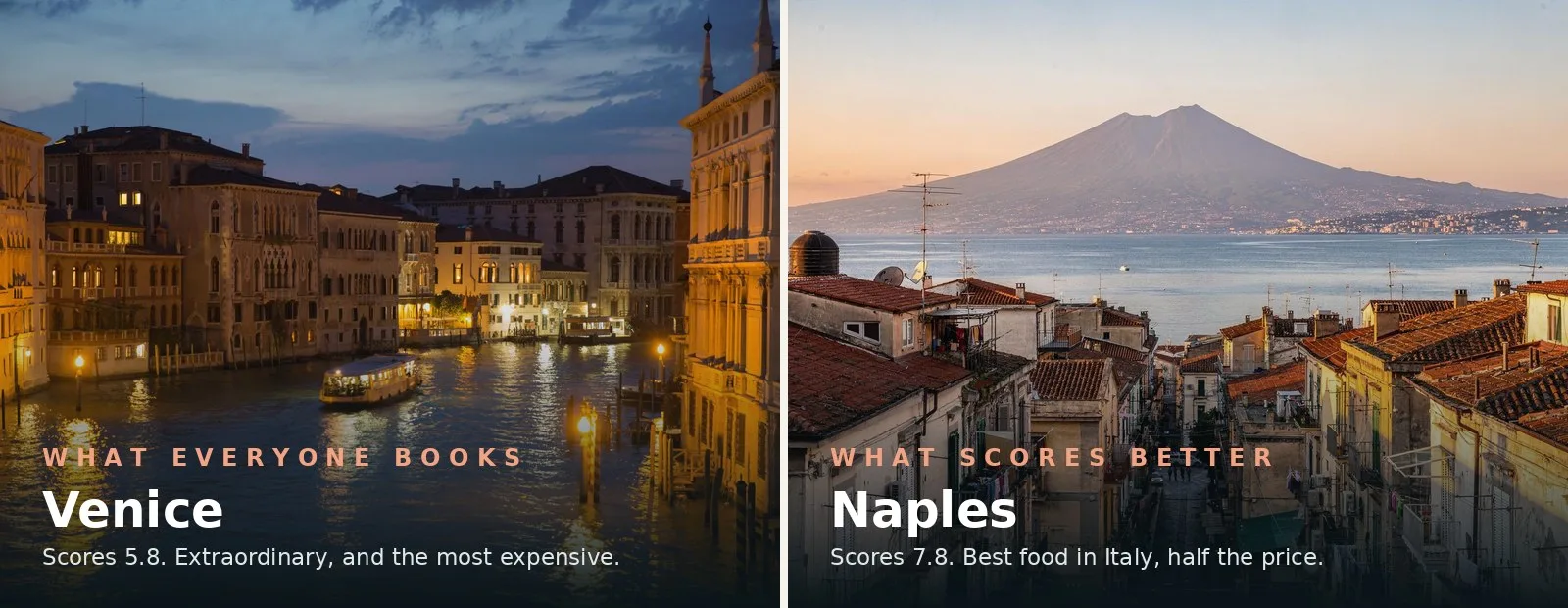
Naples, on a six-axis score: the best food in the country with strong sights, low prices and easy access. Rome wins outright on sights alone.
Venice comes last — because the scale punishes cost and crowds, and Venice is the most expensive and most crowded city on the list. It is still worth going.
The scores are our editorial judgement on a rubric printed below, not measured data. That is the point: the scale is published, so an argument about these numbers is an argument about stated criteria rather than about taste.
The best cities in Italy are Naples, Bologna, Palermo, Rome, Turin, Genoa, Florence, Lecce, Verona, Milan, Matera and Venice, in that order on our six-factor score. Naples ranks first because it combines the best food in the country with strong sights, low prices and easy access. Rome wins outright on sights. Bologna and Naples tie for food. Venice ranks last despite being extraordinary, because the score penalises cost and crowds and Venice is the most expensive and most crowded city on the list.
The best cities to visit in Italy, though, depend on what you want from the trip, which is why there are six columns below rather than one.
Every "best cities in Italy" list is the same eight cities in a slightly different order, and none of them tells you why. Rome is first because Rome is Rome. Venice is somewhere near the top because it photographs well. Nobody explains the trade-off you are actually making when you pick one.
So we built a scale, published it, and scored twelve cities on it. You can disagree with any number here, which is the point: the rubric is printed below, so an argument about our scores is an argument about stated criteria rather than about taste.
Which Italian City Should You Visit? The Short Answer
First trip to Italy: Rome, then Florence. The clichés are clichés because they are true, and a first trip is not the time to be clever.
Best food, no argument: Bologna or Naples. Bologna for the technique, Naples for the conviction.
Best value: Palermo, Lecce, Genoa. All three eat brilliantly for half what Florence costs.
Least crowded of the famous ones: Turin. A capital-grade city that almost no foreigner books.
Two cities, one week, no stress: Rome and Naples, 1h10 apart by train. Or Bologna and Florence.
Avoid in July and August: Venice and Florence. Both are unpleasant at peak, and both are wonderful in November.
How We Scored: The Rubric
Every city gets 1 to 10 on six axes. The overall score is the plain average of the six, unweighted, because a hidden weighting is just an opinion wearing a lab coat.
| Axis | 1 means | 10 means | What we anchored it to |
|---|---|---|---|
| Sights | A pleasant afternoon | You would cross a continent for this | Density of first-rank sites, not count of museums |
| Food | Fine, unmemorable | A reason to book the trip | Distinctiveness of the local kitchen and how well you eat by accident |
| Crowds | Grim at peak | Calm most of the year | Concentration of visitors on the small area that matters, not city totals |
| Cost | Punishing | Genuinely cheap | Hotel price level, plus what a normal dinner costs |
| Ease | Hard to reach, hard to move around | Fly in from anywhere, walk everywhere | Airport tier, high-speed rail access, walkability |
| Reward per day | Needs a week to make sense | Pays off in 48 hours | How much of the city you get in a short stay |
Swipe sideways for the full table →
Why these twelve. We picked cities that cover the ways travellers actually use Italy: the major cultural capitals, the food cities, the coastal and regional gateways, and the underrated alternatives people move to on a second or third trip. Siena, Padua, Parma, Bergamo, Trieste, Bari and Catania all have a case; they are day trips or regional bases rather than the cities a whole trip gets built around, which is the test we used.
Two axes are inverted so that higher is always better: Crowds 10 means uncrowded, and Cost 10 means cheap. Nothing here is scored on beauty, because every city on this list is beautiful and the word does no work.
Where the anchors come from. Hotel cost bands lean on Italian four-star pricing surveys, in which Venice sits at the top end of the country. Ease leans on which cities the Frecciarossa network actually serves, which is Rome, Florence, Bologna, Milan, Venice, Naples and Turin, and on airport tier. Crowds account for local measures a city has felt the need to introduce, of which Venice's day-tripper fee is the clearest example. Everything else is us.
The Scoreboard
| City | Sights | Food | Crowds | Cost | Ease | Reward/day | Overall |
|---|---|---|---|---|---|---|---|
| Naples | 8 | 10 | 6 | 7 | 8 | 8 | 7.8 |
| Bologna | 6 | 10 | 7 | 5 | 9 | 9 | 7.7 |
| Palermo | 8 | 9 | 7 | 8 | 6 | 7 | 7.5 |
| Rome | 10 | 9 | 4 | 4 | 10 | 7 | 7.3 |
| Turin | 7 | 8 | 8 | 6 | 7 | 8 | 7.3 |
| Genoa | 6 | 8 | 8 | 7 | 6 | 7 | 7.0 |
| Florence | 9 | 7 | 3 | 4 | 8 | 9 | 6.7 |
| Lecce | 6 | 8 | 7 | 8 | 4 | 7 | 6.7 |
| Verona | 7 | 7 | 5 | 5 | 7 | 8 | 6.5 |
| Milan | 6 | 7 | 6 | 3 | 10 | 6 | 6.3 |
| Matera | 8 | 7 | 5 | 7 | 3 | 8 | 6.3 |
| Venice | 9 | 6 | 2 | 2 | 7 | 9 | 5.8 |
Swipe sideways for the full table →
Why Venice Comes Last, and Why That Is Not What It Looks Like
Venice scores 9 for sights and 9 for reward per day. There is no other city on earth like it and two days there will mark you. It finishes bottom because it also scores 2 for crowds and 2 for cost, and a flat average punishes that hard.
That is the scale working as designed, not a verdict on Venice. It is telling you something narrower and more useful: Venice is a city you should visit, and a city you should not visit casually. Go in November, stay overnight rather than day-tripping, and it climbs several places. Go in July for one day off a cruise ship and the score is, if anything, generous.
The same logic explains Milan at 6.3. Milan is the easiest city in Italy to reach and one of the most expensive to sleep in, and it is a working city that rewards a week more than a weekend. Low score, entirely fine city.
The scatter above is the more useful picture than the ranking. The bottom-left quadrant, expensive and crowded, contains exactly the cities everyone books. The top-right, cheap and calm, contains the ones people come home talking about.
The 12 Best Cities in Italy at a Glance
- Rome — Best for History and First-Time Visitors
- Florence — Best for Renaissance Art
- Venice — Best for a Unique City Break
- Milan — Best for Design, Fashion and Getting Around
- Naples — Best for Food and Archaeology
- Bologna — Best for Food and Short Trips
- Turin — Best for Museums and a Quieter City Break
- Verona — Best for a Romantic Weekend
- Genoa — Best for Liguria and Value
- Palermo — Best for Street Food and Sicily
- Lecce — Best for Puglia
- Matera — Best for a Unique Overnight
Rome — Best for History and First-Time Visitors
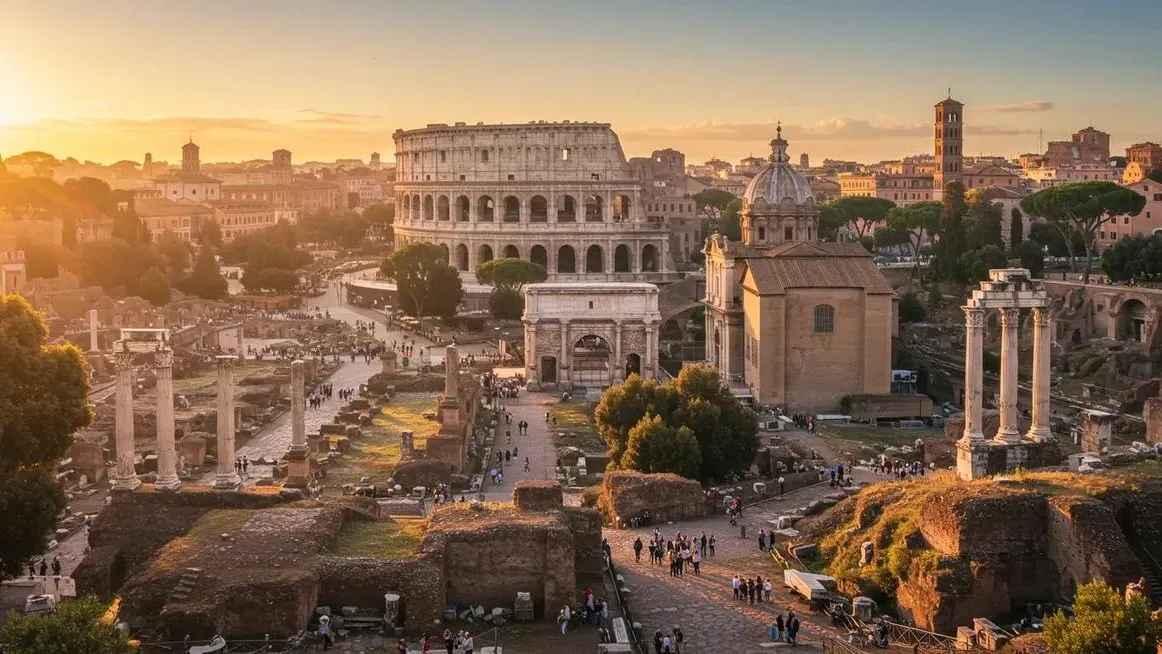
Overall score 7.3.
Sights 10 · Food 9 · Crowds 4 · Cost 4 · Ease 10 · Reward/day 7
Go for the fact that no other city stacks three thousand years on top of itself and still functions. Do not go for a relaxing week; Rome is a lot, and August Rome is a lot in 38 degrees.
Eat: the four Roman pastas, and take them seriously, because they are technique dishes rather than recipes. Cacio e pepe, carbonara, amatriciana, gricia. Then carciofi alla giudia in the Ghetto when artichokes are in season, supplì from anywhere with a queue, porchetta in a bread roll, and a maritozzo for breakfast. Eat in Testaccio or Trastevere's back streets, not on a piazza with a laminated menu.
See: the Colosseum and Forum together on one ticket, the Pantheon (free, and still the best room in Europe), the Vatican Museums early or late rather than midday, Borghese Gallery with its two-hour timed entry, and one evening simply walking from Piazza Navona to the Trevi and out to the river.
Stay: four nights minimum. Five is better. Getting there: Fiumicino connects to everywhere, and Rome is the hub of the high-speed network.
Florence — Best for Renaissance Art
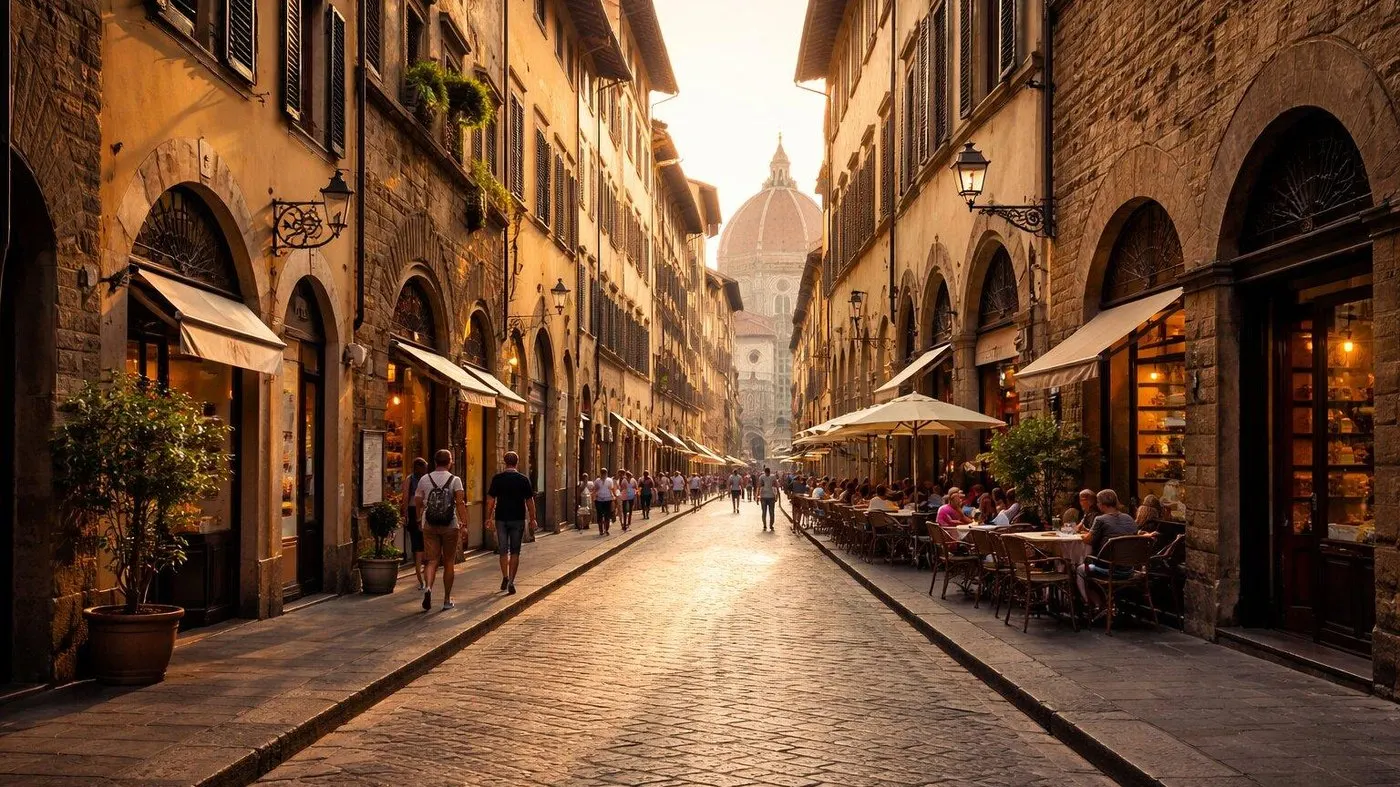
Overall score 6.7.
Sights 9 · Food 7 · Crowds 3 · Cost 4 · Ease 8 · Reward/day 9
Go for the highest concentration of Renaissance art anywhere, in a centre you can cross on foot in twenty minutes. Do not go for peace; the historic core is small and in summer it is full.
Eat: bistecca alla fiorentina if there are two of you and you accept that it comes rare. Otherwise lampredotto from a street cart, which is tripe and is much better than that sentence suggests, ribollita and pappa al pomodoro in winter, crostini di fegatini to start, schiacciata from a bakery. Tuscan food is peasant food that got famous; the simple version is the correct version.
See: the Uffizi and the Accademia, both booked in advance and both early. The Duomo complex, and specifically the climb up Brunelleschi's dome. The Bargello for sculpture, which is half empty while the Accademia queue snakes round the block. San Miniato al Monte at sunset, above the city and free.
Stay: three nights. Getting there: 1h30 from Rome, around 2h from Venice by high-speed rail.
Venice — Best for a Unique City Break
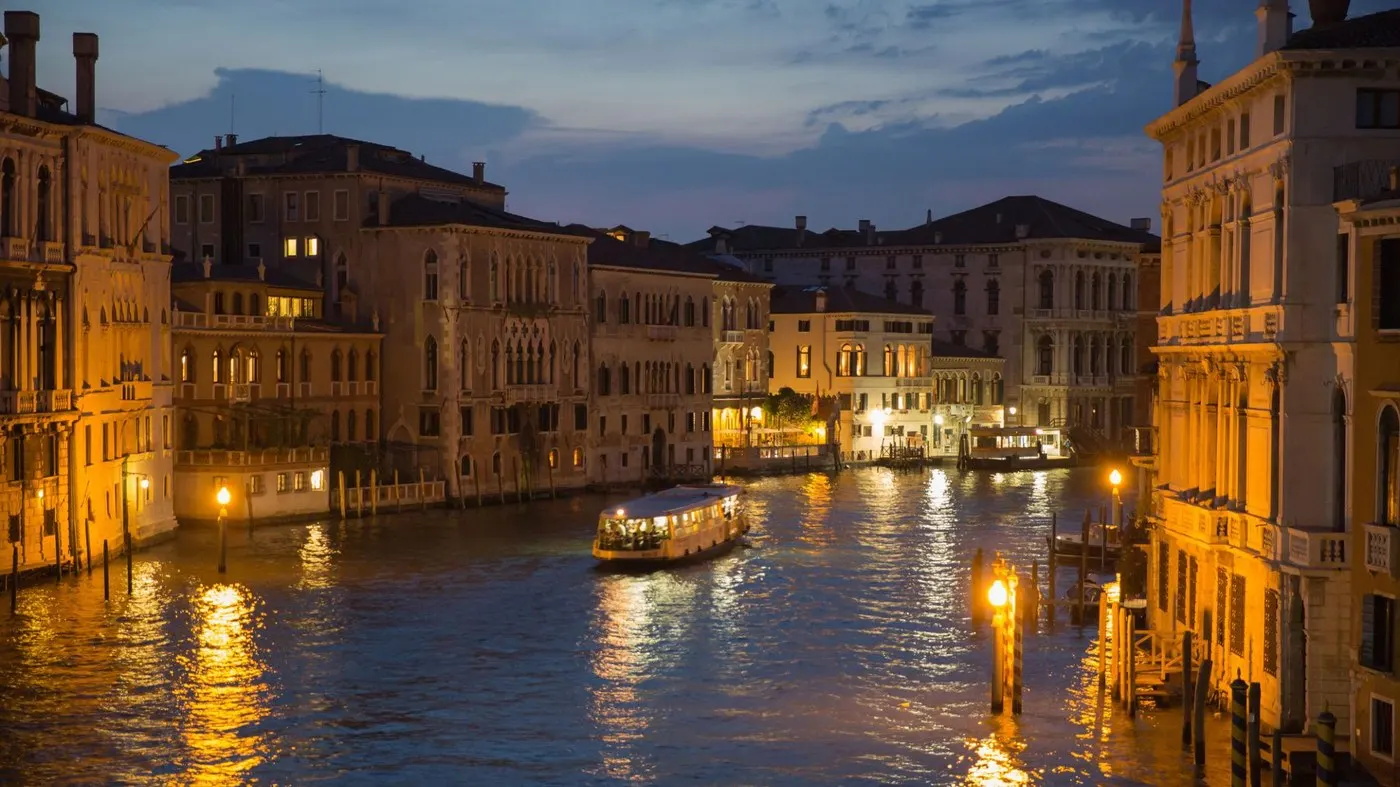
Overall score 5.8.
Sights 9 · Food 6 · Crowds 2 · Cost 2 · Ease 7 · Reward/day 9
Go for the only city in the world built on water that still works as a city. Do not go for value, or in August, or for one day off a ship.
Eat: cicchetti, standing up, in bacari, which is Venice's one great everyday food tradition and the thing most visitors miss entirely. Sarde in saor, baccalà mantecato on white polenta, folpetti. Risi e bisi in spring, moeche when the soft-shell crabs are running. Avoid anywhere with a picture menu near San Marco, which is most things near San Marco.
See: the Basilica di San Marco early, the Doge's Palace, and the Accademia. Then leave the tourist spine: Cannaregio in the evening, the Jewish Ghetto (the original one, which gave the word to every other), and a vaporetto down the Grand Canal at night.
Stay: two or three nights, and stay in the city rather than in Mestre. Getting there: 3h45 from Rome, around 2h30 from Milan. Note the day-tripper fee below.
Milan — Best for Design, Fashion and Getting Around
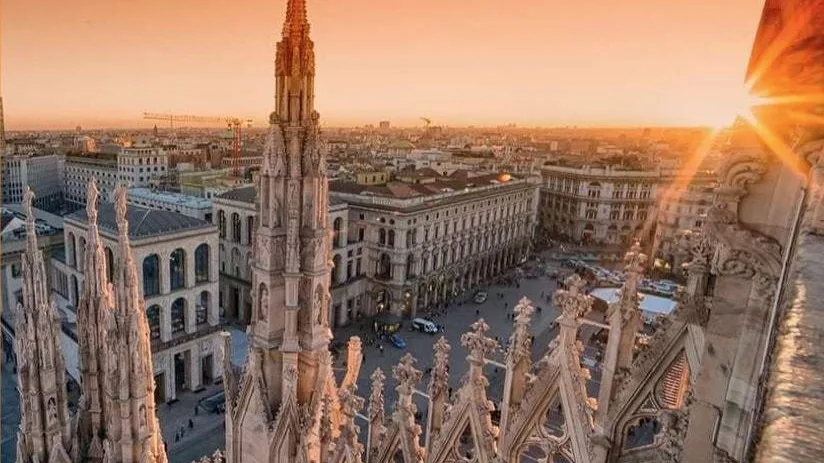
Overall score 6.3.
Sights 6 · Food 7 · Crowds 6 · Cost 3 · Ease 10 · Reward/day 6
Go for design, opera, shopping, aperitivo, and the fact that you can fly here from anywhere and be in Venice or Florence in a couple of hours. Do not go for a picture-postcard Italian city break; Milan is a working northern metropolis and it does not care whether you like it.
Eat: risotto alla milanese, saffron and bone marrow, which is one of Italy's great dishes and rarely made well outside Lombardy. Cotoletta alla milanese, ossobuco, cassoeula in winter. Panettone at Christmas from a proper pasticceria. Then take aperitivo seriously, because Milan invented the version everyone else copies.
See: the Duomo and, more importantly, its roof. Leonardo's Last Supper, which needs booking weeks ahead. The Brera gallery, the Navigli in the evening, and Fondazione Prada if contemporary art is your thing.
Stay: two nights, or use it as a base. Getting there: three airports and the northern rail hub. 2h55 to Rome.
Naples — Best for Food and Archaeology
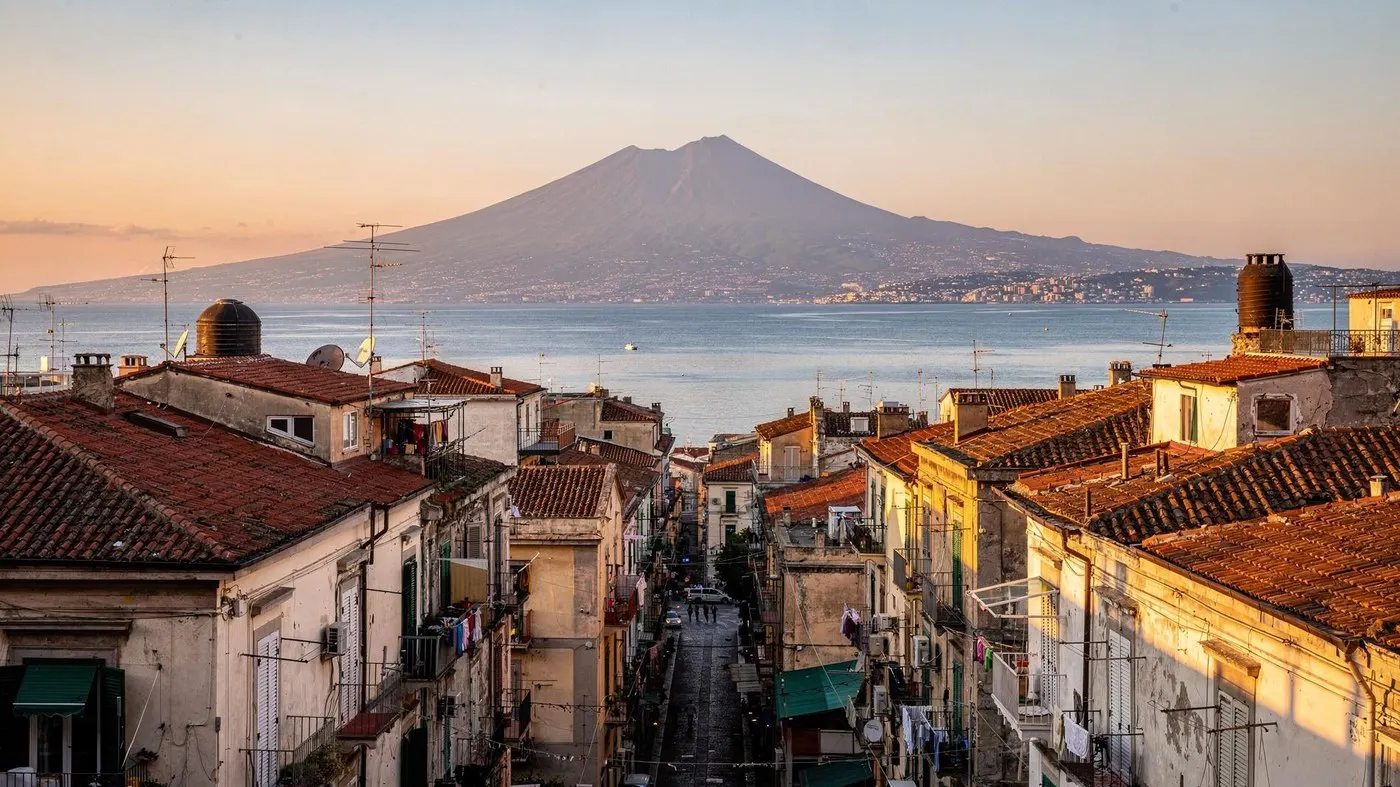
Overall score 7.8.
Sights 8 · Food 10 · Crowds 6 · Cost 7 · Ease 8 · Reward/day 8
Go for the best eating in Italy, an archaeological museum that outranks anything in Rome for Roman objects, and Pompeii, Herculaneum and the Amalfi Coast all within an hour. Do not go for order. Naples is loud, fast and slightly overwhelming for the first six hours, and then it is the most alive city in the country.
Eat: pizza, obviously, in a pizzeria with a queue of locals and no tablecloth. But also ragù napoletano, which is a different animal from bolognese and cooks for most of a day. Pasta e patate con provola, friarielli with sausage, sfogliatella riccia for breakfast, babà, and coffee standing at the bar because sitting down doubles the price.
See: the Museo Archeologico Nazionale, which holds the best of what came out of Pompeii. Cappella Sansevero for the Veiled Christ. Napoli Sotterranea under the old centre. Then day trips: Pompeii and Herculaneum, with Herculaneum the smaller and better preserved of the two.
Stay: three nights, four if you want the ruins properly. Getting there: 1h10 from Rome by high-speed rail, and an international airport in the city.
Bologna — Best for Food and Short Trips
Overall score 7.7.
Sights 6 · Food 10 · Crowds 7 · Cost 5 · Ease 9 · Reward/day 9
Go for food, porticoes and the fact that it is the crossroads of the Italian rail network, so everything else is close. Do not go for blockbuster sights; Bologna's pleasure is ambient rather than ticketed.
Eat: tagliatelle al ragù, which is what the rest of the world calls bolognese and gets wrong. Tortellini in brodo, which is the real local religion and best in winter. Lasagne verdi, mortadella sliced properly, crescentine and tigelle with squacquerone. Then day-trip to Modena for balsamic and to Parma for prosciutto and parmigiano, both under an hour away.
See: the two leaning towers, Piazza Maggiore, the Basilica di San Petronio, the Archiginnasio anatomical theatre, and the 40 kilometres of porticoes that are now a UNESCO site. Walk the portico up to San Luca if the weather is kind; it is 3.8 kilometres of covered arcade uphill.
Stay: two or three nights, more if you are using it as a base. Getting there: every high-speed line in Italy passes through Bologna, which is precisely the point.
Turin — Best for Museums and a Quieter City Break
Overall score 7.3.
Sights 7 · Food 8 · Crowds 8 · Cost 6 · Ease 7 · Reward/day 8
Go for a grand baroque capital that almost no foreign tourist books, an Egyptian museum second only to Cairo's, and café culture that predates every other city's. Do not go for sun; Turin is a northern city with northern weather and it can be grey.
Eat: agnolotti del plin, vitello tonnato, bagna càuda in autumn with a table of friends. Drink bicerin, the local layered coffee, chocolate and cream. Eat gianduiotto, since Turin invented chocolate and hazelnut together. Turin also invented vermouth and the aperitivo hour, and both are still done better here than anywhere.
See: the Museo Egizio, which is genuinely world class. The Mole Antonelliana and its cinema museum. Palazzo Reale, the covered arcades, and a day trip out to the Sacra di San Michele or into the Langhe for wine.
Stay: two or three nights. Getting there: roughly an hour from Milan, on the high-speed spine. The airport is small.
Verona — Best for a Romantic Weekend
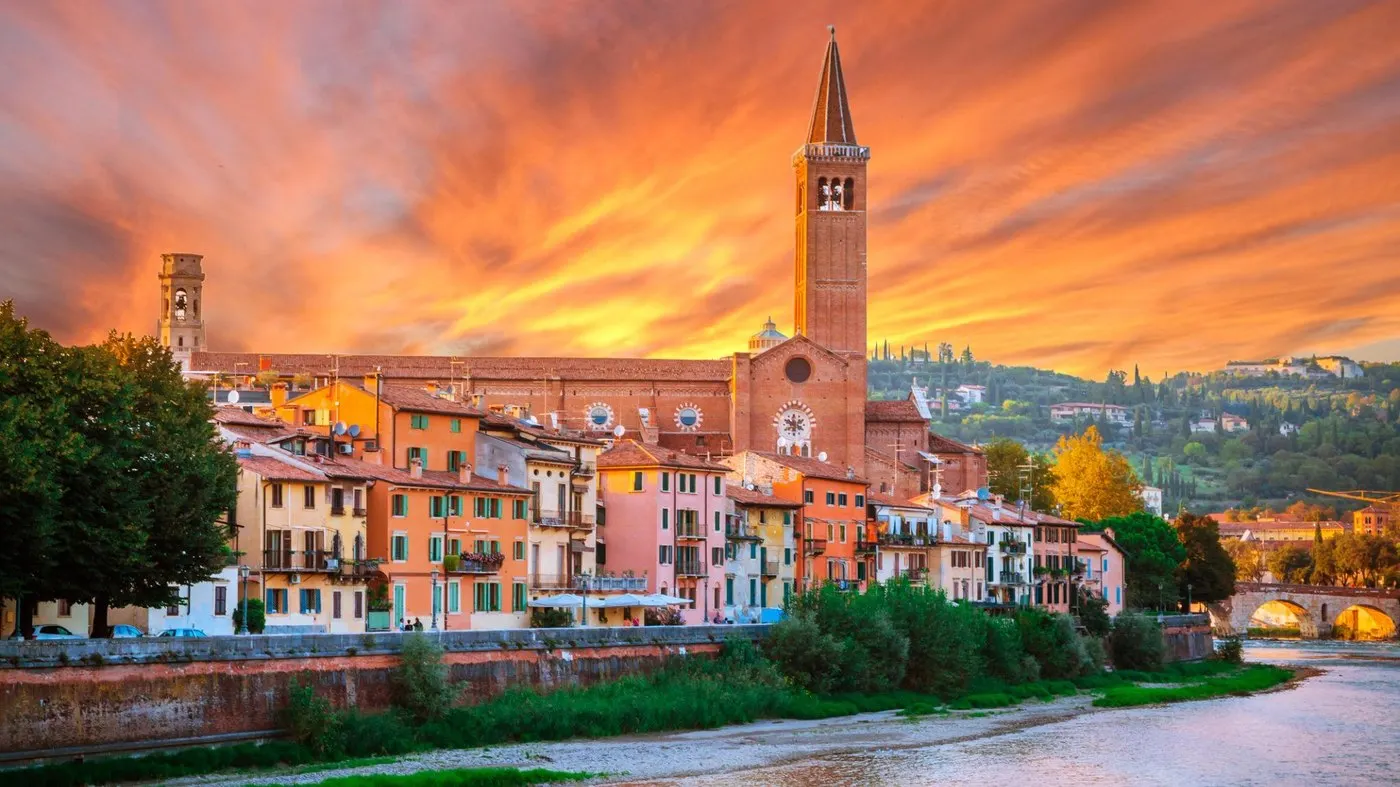
Overall score 6.5.
Sights 7 · Food 7 · Crowds 5 · Cost 5 · Ease 7 · Reward/day 8
Go for a Roman arena that still hosts opera every summer, a compact and genuinely lovely centre, and Lake Garda and Valpolicella on the doorstep. Do not go for the Juliet balcony, which is a twentieth-century invention with a courtyard full of people photographing it.
Eat: risotto all'Amarone, bigoli with duck ragù, and the local bollito misto in winter. Drink the region: Valpolicella, Amarone, Soave and Bardolino are all within half an hour. Pandoro at Christmas is Veronese, not Milanese.
See: the Arena, ideally with a ticket to an opera rather than just a walk around it. Castelvecchio and its bridge. Piazza delle Erbe. Then Valpolicella wineries or Lake Garda for a day.
Stay: two nights. Getting there: on the Milan to Venice corridor, so easy from either.
Genoa — Best for Liguria and Value
Overall score 7.0.
Sights 6 · Food 8 · Crowds 8 · Cost 7 · Ease 6 · Reward/day 7
Go for the largest medieval old town in Europe, a working port with no interest in charming you, and Liguria's food. Do not go for polish; Genoa is scruffy in places and that is most of its character.
Eat: pesto, made here, on trofie with potato and green beans, which is how Ligurians actually eat it. Focaccia genovese for breakfast, farinata, pansoti with walnut sauce, and cappon magro if you find it. Ligurian food is the best argument in Italy for olive oil over butter.
See: the caruggi, the dense medieval lanes behind the port. The Rolli palaces, a UNESCO site and open on set days. Via Garibaldi's museums. Then the Cinque Terre and Portofino, both close, both better as day trips than as bases.
Stay: two nights, plus coast time. Getting there: off the high-speed spine, so slower than the numbers suggest. A small airport.
Palermo — Best for Street Food and Sicily
Overall score 7.5.
Sights 8 · Food 9 · Crowds 7 · Cost 8 · Ease 6 · Reward/day 7
Go for Norman, Arab and Byzantine architecture layered in the same buildings, Europe's best street food, and prices that feel like a mistake. Do not go for efficiency; Palermo runs at its own speed and traffic is a contact sport.
Eat: the street food first. Panelle, chickpea fritters in a roll. Arancine. Sfincione, the thick Palermitan pizza. Pane con la milza if you are brave, which is spleen and is a genuinely great sandwich. Then caponata, pasta con le sarde, cannoli filled to order and never before, and granita with a brioche for breakfast in summer.
See: the Cappella Palatina in the Norman Palace, which is one of the most beautiful rooms in Europe. Monreale cathedral's mosaics, just outside town. The Ballarò and Capo markets. The Capuchin catacombs if you have the stomach.
Stay: three nights, more with Sicily around it. Getting there: international airport, but no high-speed rail, so fly.
Lecce — Best for Puglia
Overall score 6.7.
Sights 6 · Food 8 · Crowds 7 · Cost 8 · Ease 4 · Reward/day 7
Go for baroque carved in soft golden limestone across a whole small city, and Puglia around it. Do not go for a standalone trip; Lecce is the base for a region rather than a destination on its own.
Eat: pasticciotto, a warm custard pastry, for breakfast, every day. Rustico leccese, puccia sandwiches, orecchiette with cime di rapa, and raw seafood on the coast. Drink Primitivo and Negroamaro, both local and both better value than anything from Tuscany.
See: the Basilica di Santa Croce, the Roman amphitheatre in the main piazza, and the papier-mâché workshops that are a genuine local craft. Then the coast: Otranto, Gallipoli, and the Adriatic beaches an hour away.
Stay: two nights in the city, a week in Puglia with a car. Getting there: the hard part. Brindisi airport is 40 minutes away, and the train from Rome is a long one.
Matera — Best for a Unique Overnight
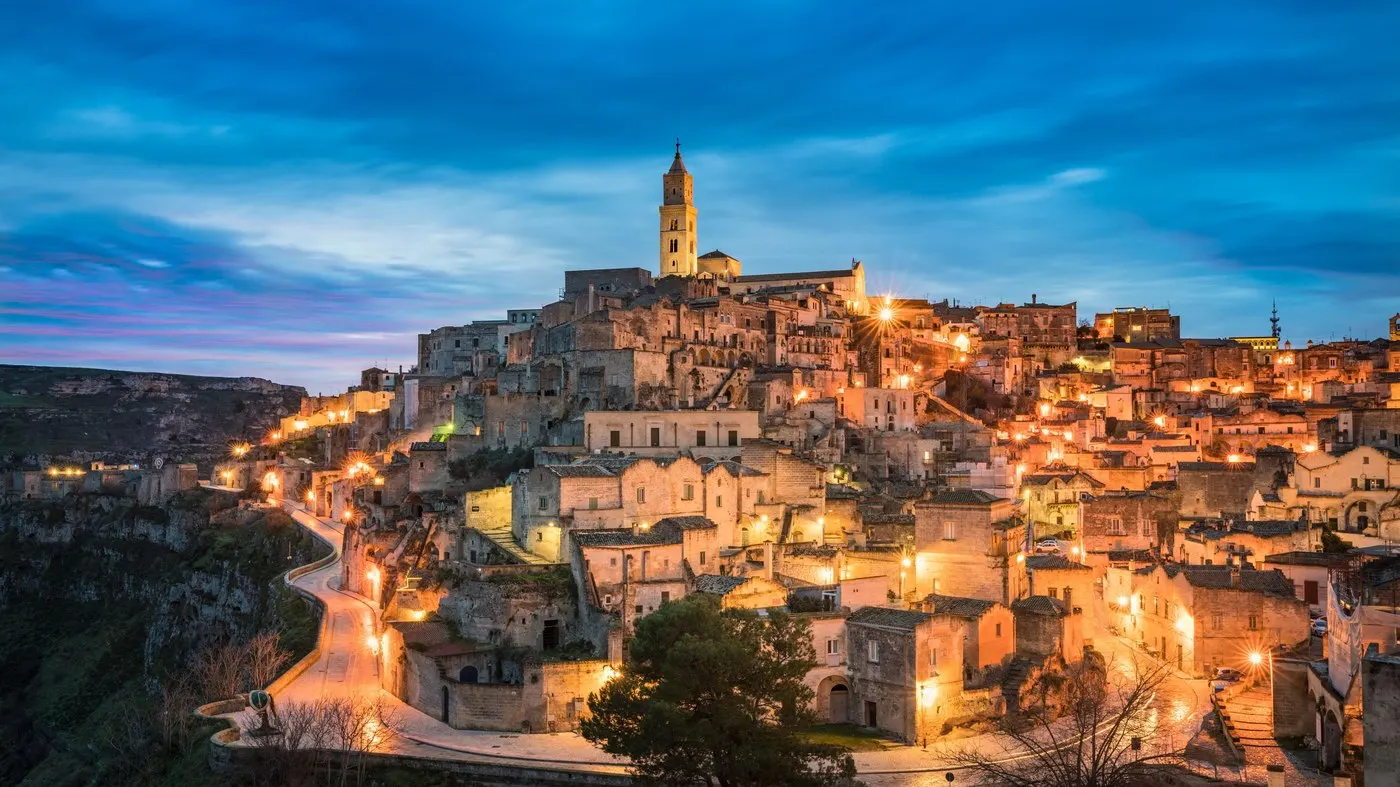
Overall score 6.3.
Sights 8 · Food 7 · Crowds 5 · Cost 7 · Ease 3 · Reward/day 8
Go for the Sassi, cave dwellings inhabited continuously for thousands of years, evacuated as a national disgrace in the 1950s and now a UNESCO site and a hotel district. There is nowhere else like it in Europe. Do not go for convenience; getting here is the whole problem.
Eat: pane di Matera, a huge sourdough with protected status. Peperoni cruschi, dried sweet peppers fried until they shatter. Cialledda, orecchiette, and hearty Lucanian food built for people who worked outdoors.
See: the Sassi themselves, at dawn and again after dark when they are lit. The rock churches with their frescoes. A cave hotel is worth the money here, since the accommodation is the sight.
Stay: two nights, which is enough. Getting there: no airport and no mainline station. Bari is the usual approach, then a bus or the regional line, roughly 1h30.
Which Two Cities Should You Combine?
Italy rewards two cities in a week far more than four. The high-speed network makes this easy on the Turin to Naples spine and hard everywhere else, which is the single most useful planning fact in the country.
| Pairing | Train time | Why it works |
|---|---|---|
| Rome + Naples | 1h10 | The two best food cities on the list, an hour apart, with Pompeii between them |
| Bologna + Florence | Under 40 min | Best food and best art, and Bologna costs half what Florence does |
| Florence + Venice | ~2h | The classic first-trip pair. Do Venice second and stay overnight |
| Milan + Venice | ~2h30 | Fly into Milan, end in Venice, no backtracking |
| Rome + Florence | ~1h30 | The default first trip, and the default for good reason |
| Turin + Genoa | ~1h45 | The contrarian week. Almost no other foreigners doing it |
Swipe sideways for the full table →
Two pairings to think twice about. Rome and Venice is 3h45 each way, which is fine as a one-way but wasteful as a round trip. And anything that pairs a northern city with Palermo, Lecce or Matera means a flight or most of a day on a train, so treat the south as its own trip rather than an add-on.
Best Italian Cities by Travel Style
A shortcut through the scoreboard, for people who already know what they want.
Best Italian Cities for Food
Bologna and Naples, then Palermo. Bologna is the technical capital and puts Parma and Modena within an hour. Naples is the best cheap eating in the country. Palermo has the best street food in Europe and charges almost nothing for it.
Best Cities in Italy for a First Trip
Rome and Florence, connected by a 1h30 train. Add Venice if you have nine or ten days rather than seven.
Best Value Cities in Italy
Palermo, Lecce, Genoa, Naples and Matera, all scoring 7 or 8 on cost. The gap is not small: southern cities routinely cost half what Venice or Milan does for a better dinner.
Best Italian Cities for a Weekend
Bologna, Florence, Venice and Verona, all scoring 8 or 9 on reward per day. Rome and Milan are the two worst weekend cities here, for opposite reasons: Rome needs more time, Milan needs more reason.
Least Crowded Cities in Italy
Turin and Genoa, both 8, then Bologna, Palermo and Lecce at 7. Turin is the anomaly worth acting on: a former royal capital with a world-class Egyptian museum that foreign visitors mostly skip.
Best Italian Cities in Winter
Turin, Bologna, Rome and Venice. Turin and Bologna are indoor cities with heavy winter food and covered arcades to walk under. Rome is mild and finally walkable. Venice in fog and low season is the version people write about.
Best Italian Cities in Summer
Genoa, Lecce, Palermo and Verona, because all four give you a coast or a lake within an hour and none of them concentrates its crowd into a few hundred metres. Avoid Florence and Venice in July and August, and treat Rome in August as a heat decision as much as a travel one.
What No Guide Tells You
The famous city in November beats the quiet city in August. Florence in low season is a different and much better city than Florence in July, and it costs less. If your dates are movable, move the dates before you downgrade the destination.
Reward per day is the axis nobody thinks about and everybody feels. Venice and Florence hand you almost everything in 48 hours. Rome and Milan do not. Booking three nights in Rome is the most common Italian planning mistake, and it is not close.
Your food score is mostly decided by where you sit down, not which city you chose. Every city on this list has a tourist ring where the food is bad and a residential belt ten minutes' walk away where it is excellent. In Rome that is Testaccio, in Venice it is Cannaregio, in Florence it is Sant'Ambrogio, in Palermo it is wherever the market is. The walk is the whole trick.
Two of the twelve charge you to arrive, and the rules move. Venice ran a day-tripper access fee on 60 peak days between 3 April and 26 July 2026, at €5 booked more than four days ahead or €10 booked later, applying between 08:30 and 16:00 and not to overnight guests. That trial ended on 27 July 2026. Whether it returns, and on which dates, has been decided year by year, so check before you travel rather than trusting an article, including this one.
The train is the reason to do Italy as cities. Six sourced city pairs on this page are under three hours. In most of Europe that buys you one country; in Italy it buys you a completely different cuisine.
Still Not Sure?
That is reasonable, because the honest answer depends on things a list cannot know: your dates, your budget, how much moving around you will tolerate, and whether you would rather queue for the Uffizi or eat in a market — which is the narrowing how Escapada works describes.
Tell Max when you are going, where you are flying from and what the trip is for. He will narrow the twelve down, put the pair that actually connects on your dates in the right order, and build the trip around it. He will also tell you when the answer is to shift your week rather than change your city.
Max will ask about ages, dates and budget — and build an itinerary with flights, hotels and things to do.
Frequently Asked Questions
What is the best city in Italy to visit?
On our scale, Naples, because it combines the best food in the country with strong sights, low prices and easy access. On sights alone the answer is Rome, and it is not close. Which of those is "best" depends entirely on what you are optimising for, which is why the scoreboard has six columns instead of one.
Which Italian city has the best food?
Bologna and Naples, for different reasons. Bologna is the technical capital: fresh egg pasta, ragù, tortellini in brodo, with Parma and Modena within an hour. Naples is the conviction capital: pizza, ragù napoletano, and the best cheap eating in Italy. Palermo is third and closer than most people expect.
Which city in Italy is best for first-time visitors?
Rome, then Florence, connected by a 1h30 train. It is the obvious answer and it is the right one. Save the second-tier cities for the second trip, when you are not also trying to see the Colosseum.
Is Venice worth visiting?
Yes, and it finishes last on our scale anyway. Venice scores 9 for sights and 9 for reward per day, and 2 for both crowds and cost, which a flat average punishes. Go for two or three nights, stay in the city rather than day-tripping, and go outside July and August.
Which Italian city is the cheapest?
Palermo and Lecce, followed by Genoa, Naples and Matera. Southern cities are dramatically cheaper than Venice, Milan or Florence for the same standard of room and a better dinner.
How many days do you need in Rome?
Four nights minimum, five if you want the Vatican, the Borghese and the ancient sites without sprinting. Three nights in Rome is the most common mistake on this list. Florence works in three, Venice in two or three, Bologna and Verona in two.
What are the best two cities to combine in one week in Italy?
Rome and Naples, 1h10 apart, if you care about food. Florence and Venice, around 2h apart, for a first trip. Bologna and Florence, under 40 minutes apart, if you want the art without the Florence hotel bill.
Which Italian city is best for a weekend?
Bologna, Florence, Venice or Verona. All four score 8 or 9 on reward per day, meaning a short stay gets you most of what the city has. Rome and Milan are the weakest weekend cities here, for opposite reasons.
Is Naples worth visiting, and what is it actually like?
Yes, and it is louder and faster than anywhere else on this list. It takes a few hours to adjust to the traffic and the noise. Ordinary city sense applies: watch your bag on the metro and in crowds, as you would in any big southern European city. What you get in return is the best food in Italy, the finest Roman collection anywhere, and Pompeii on the doorstep.
Which Italian cities are least crowded?
Turin and Genoa, both scoring 8, then Bologna, Palermo and Lecce at 7. Turin is the standout: a former royal capital with a world-class Egyptian museum that foreign visitors largely skip.
Do you have to pay to enter Venice?
Only as a day-tripper, on specific dates, and the scheme is renewed year by year. In 2026 it ran on 60 peak days between 3 April and 26 July, costing €5 if booked more than four days ahead and €10 if booked later, between 08:30 and 16:00. Overnight guests, children under 14 and residents were exempt. The trial ended on 27 July 2026, so check the current rules before you travel.
Which Italian cities are best without a car?
All twelve. Italian cities are walkable and the intercity trains are good, and a car in a historic centre is a liability rather than an asset, thanks to the ZTL restricted-traffic zones that will fine you by post. You want a car for Puglia around Lecce, for Liguria beyond Genoa, and for Tuscany beyond Florence, not for the cities themselves.
Which Italian cities are best for 2 to 3 days?
Bologna, Florence, Venice and Verona, which score 8 or 9 on reward per day. Turin and Matera also work well in two. Rome needs four nights and Milan repays a week more than a weekend.
What are the most underrated cities in Italy?
Turin, Genoa and Palermo. Turin is a grand baroque capital with an Egyptian museum second only to Cairo's and almost no foreign visitors. Genoa has the largest medieval old town in Europe and is scruffy enough to put people off. Palermo has Norman and Arab architecture, Europe's best street food, and prices that feel like an error.
When is the best time to visit Italian cities?
Late April to early June, and late September to early November. Warm enough, open, and without the July and August combination of heat and crowds. Winter is genuinely good for Rome, Bologna, Turin and Venice if you do not mind cold and short days, and it is when prices fall furthest.
Can you get around Italy by train?
On the main spine, yes, and it is the best way to do it: Rome to Florence in about 1h30, Rome to Naples in about 1h10, Rome to Milan in about 2h55, Florence to Venice in about 2h, Milan to Venice in about 2h30. Off that spine it thins out fast. Palermo, Lecce and Matera are all better reached another way.
Which Italian city is best for food and wine together?
Turin, if you want both in one place: Piedmontese cooking plus Barolo and Barbaresco an hour away, and the city that invented vermouth. Verona is the other answer, with Valpolicella, Amarone and Soave on the doorstep.
Sources and Further Reading
- Venezia Unica, the official Venice access fee page — the €5 and €10 booking rule, the areas covered, and confirmation that the trial ended on 27 July 2026.
- Untold Italy on the Venice tourist tax — the 60 applicable dates between 3 April and 26 July 2026, and the exemption categories.
- Untold Italy's guide to Italian trains — high-speed journey times and fare ranges for the city pairs used above.
- Seat 61 on the Frecciarossa — fastest scheduled times on the main routes and which cities the network serves.
- Statista, average four-star hotel price by Italian city — the survey placing Venice at the expensive end of the Italian market, used as an anchor for the Cost column.
Related Guides
- Should You Book Now or Wait? When to Book Flights and Hotels — what actually moves the price of the flight and the room you are about to book for this trip.
- Which Greek Island Should You Visit? A Decision Guide — the same method applied to a country where the logistics matter even more.
- Which Brazil Destination Should You Visit? — constraints before taste again, over a country where the distances are the constraint.
We build an AI travel agent that plans and books trips, so we spend a lot of time comparing places on things that can actually be compared. The six scores here are our editorial judgement on the published rubric, not measured data, and we would rather you argue with the rubric than trust the number. Prices, fees and timetables change often.